
Online school for international business
Learn how companies grow across borders, one step at a time.
From the first order abroad to running a business in several countries. Short, clear lessons with worked cases, slides, quizzes and narrated videos. No prior knowledge needed.
22 lessons · 2 modules · new lessons every week
Plain language
Every idea explained from the ground up, with the jargon translated.
Worked cases
Each lesson follows an invented company through a real decision, step by step.
Everything included
Lesson PDF, slides, PowerPoint, narrated video and a quiz for every lesson.
Learn at your pace
Watch, read or print. Keep the files and come back whenever you need them.
What you will be able to do
- Explain why companies go international, and what really changes when they do
- Read a balance sheet and an income statement, and judge a company's health
- Analyse a foreign market, its customers and its competitors
- Weigh culture, sustainability and risk in business decisions
- Plan a market-entry project and present it in a clear report
The course
International Business, Step by Step: two modules, 22 lessons.
Module 1 Exploring Internationalisation 13 lessons
- 01What internationalisation means for a companyAvailable
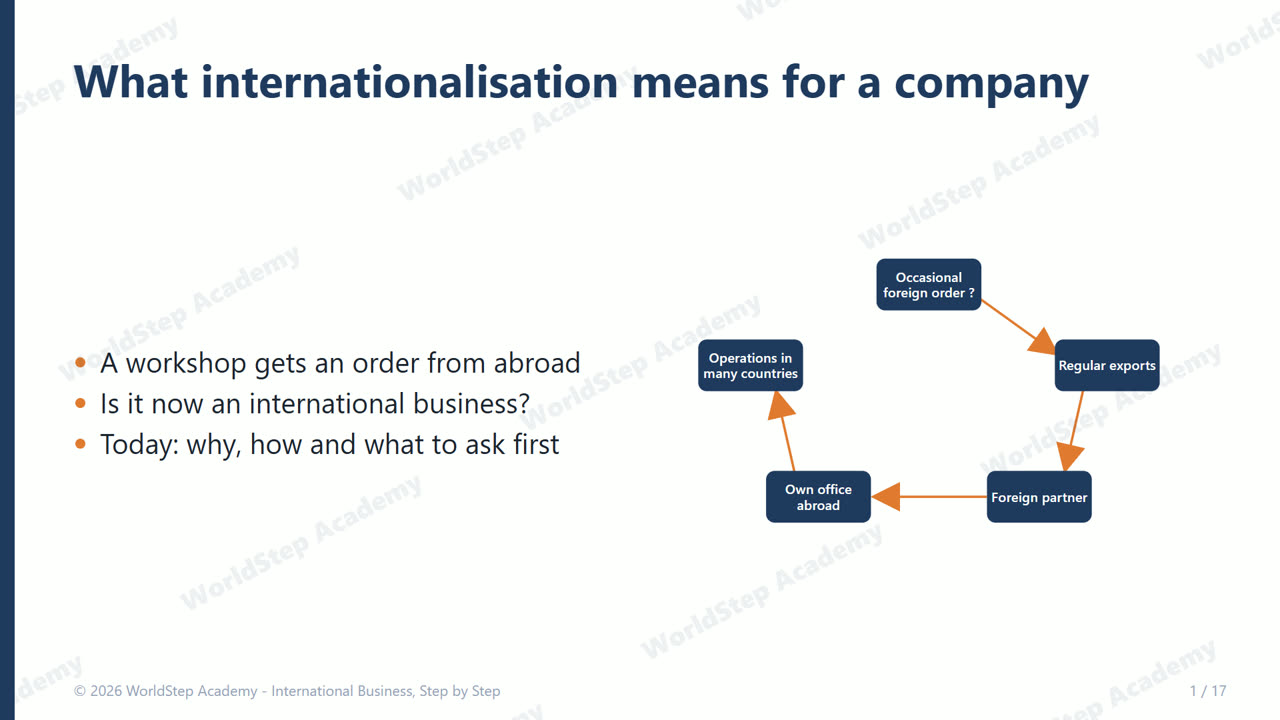
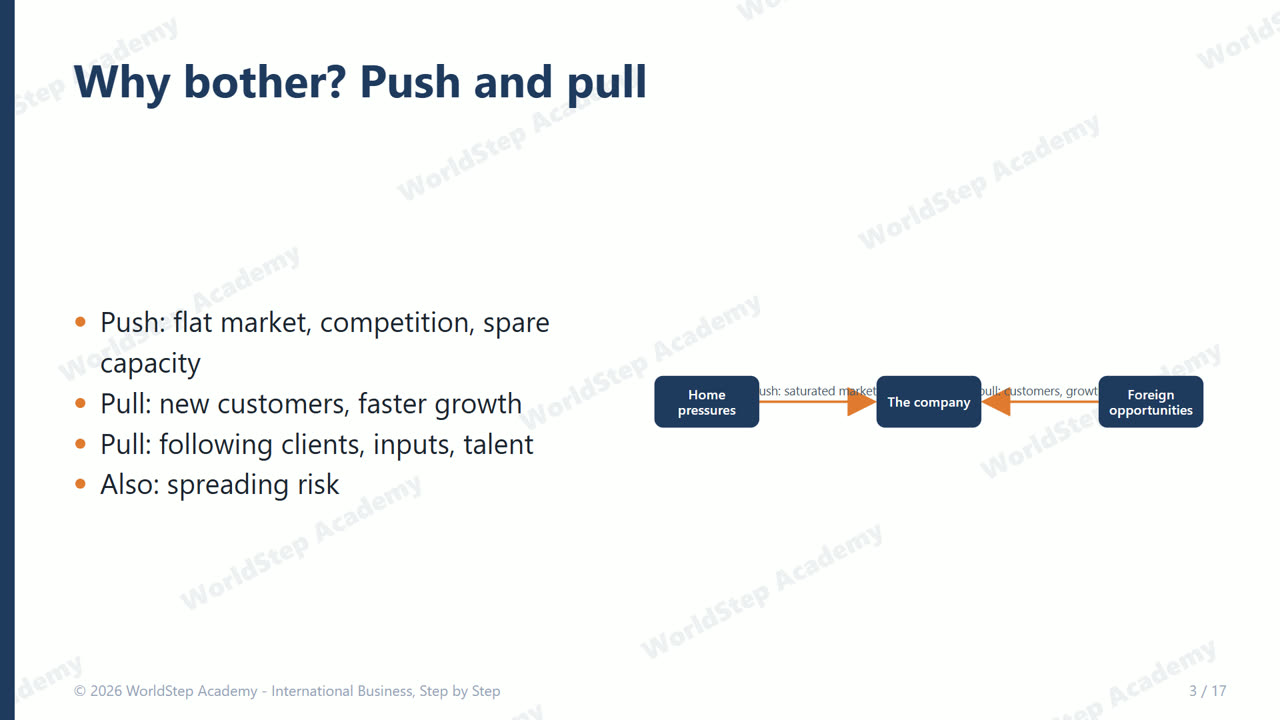
You will understand why and how companies move beyond their home market, the main forms this takes (exporting, partnerships, local presence) and the questions a business must answer before it goes abroad. You will be able to read a short company profile and list the opportunities and risks of its international plans.
- 02Value creation and the marketing mix: promotionComing
You will understand how a business creates value for customers and how that value is communicated. You will learn the promotion part of the marketing mix and be able to judge whether a company's messages and channels fit its audience.
- 03Place, price and the full marketing mixComing
You will learn how distribution (place) and pricing decisions fit together with product and promotion. You will be able to describe a company's complete mix and spot where the pieces do not match.
- 04Business types, ownership and legal basicsComing
You will learn the common legal forms a business can take, what each means for owners' liability and control, and how contracts work at a basic level. You will be able to recommend a suitable form for a small venture and explain a simple contract clause.
- 05Stakeholders and organisational structureComing
You will learn who has an interest in a business (owners, staff, customers, suppliers, communities) and how companies organise people and decisions through different structures. You will be able to draw a simple organisation chart and map a company's stakeholders by influence.
- 06Reading the balance sheet and income statementComing
You will learn what a balance sheet and an income statement show, how debits and credits work, and what drives a company's value. You will be able to build both statements from simple transactions and explain what they say about a firm's position.
- 07Analysing financial statements and types of spendingComing
You will learn to compare figures, use simple ratios, and tell apart capital, financing, operating and revenue spending. You will practise working in a spreadsheet and be able to judge a small company's financial health from its statements.
- 08Analysing the micro- and macro-environmentComing
You will learn to examine the forces close to a company (customers, competitors, suppliers) and the wider forces around it (economic, political, social, technological, legal, environmental). You will be able to run a structured environment scan and pull out the findings that matter.
- 09Culture and its effect on businessComing
You will learn what culture is, how cultural dimensions are used to compare countries, and how differences shape negotiation, teamwork and customer behaviour. You will be able to separate cultural from personal explanations of behaviour and avoid common stereotypes.
- 10Sustainability in business: the basicsComing
You will understand what sustainability means for a company, why it matters to customers, investors and regulators, and how a business can create value while limiting harm. You will be able to name sustainability issues in a company's operations and suggest sensible responses.
- 11Finding and judging informationComing
You will learn where to look for reliable business information, how to test a source for currency, relevance, authority, accuracy and purpose, and how to think critically about claims. You will be able to defend a choice of sources and spot weak evidence.
- 12Writing a clear business reportComing
You will learn how a business report is structured, how to write an introduction and executive summary, use headings, cite sources, and acknowledge the use of AI tools. You will practise editing for clarity, punctuation and sentence structure, and be able to draft and improve a short report section.
- 13Presenting findings visuallyComing
You will learn how to turn research findings into a clear infographic, choosing themes, a layout and a message that suits the reader. You will be able to design a one-page visual summary of a market or company.
Module 2 Entering Foreign Markets: Market, Customer and Competitor Profiling 9 lessons
- 14Planning a market-entry projectComing
You will learn how to set the goal of a project, break it into tasks, assign roles and plan the time. You will be able to write a realistic project plan and keep a team on track.
- 15Market research methodsComing
You will learn the difference between desk and field research, qualitative and quantitative methods, and how to pick sources and sample sizes. You will be able to design a small research plan and collect usable data about a foreign market.
- 16Building a market profileComing
You will learn which facts describe a foreign market: size, growth, demand, rules and buying habits. You will be able to gather these facts and present them as a short, clear market profile.
- 17Competitor analysis, including digital competitorsComing
You will learn how to identify direct and indirect competitors and compare their offers, prices, positioning and online presence. You will be able to produce a competitor profile and find the gaps a newcomer could use.
- 18Customer segmentation and personasComing
You will learn to divide a market into groups with shared needs and behaviours, choose which to target, and describe a typical customer as a persona. You will be able to build segments from data and justify your target choice.
- 19Costing and financial planning for a new marketComing
You will learn how costs, margins and break-even work, and how to build a simple financial template for selling in a new market. You will be able to estimate whether an offer can make a profit abroad.
- 20Storytelling and profiling in business communicationComing
You will learn to present a market and its customers as a clear story with a point, supported by evidence, written and spoken. You will be able to shape findings for a specific audience.
- 21Ethical claims, labels and greenwashingComing
You will learn how sustainability labels and licences work, how to recognise misleading green claims, and how the global development goals frame business responsibility. You will be able to test an environmental claim and relate a product to the goals.
- 22Building your professional profileComing
You will learn how to explore your strengths and goals and present them online, including a strong professional networking profile. You will be able to write a short self-description and set career steps.
One price, every lesson
Join now at the early-access price and you get every lesson as it is released, plus all future updates.
Not sure yet? Take the first lesson free, with no card needed.
Becomes €79 when the course is complete
- All 22 lessons as they are released
- PDF, slides, PowerPoint, video and quiz for every lesson
- Module tests with answer keys
- Every future update, at no extra cost
- 30-day money-back guarantee
Launch code FIRSTSTEP takes €10 off for the first 100 students.
Questions
Who is this course for?
Anyone starting out in international business: students, people who want to work in export or import, and small-business owners thinking about selling abroad. No prior business knowledge is needed.
What exactly do I get?
Every lesson comes as a written lesson (PDF) with a worked case, slides as PDF and as an editable PowerPoint, a narrated video with captions, and a quiz with answers. Each module ends with a test and an answer key.
What does early access mean?
The course is being released lesson by lesson. 1 of 22 lessons are out now and new ones follow about twice a week. You pay the early-access price once and get every lesson and update as it is released.
How do I get the lessons after paying?
Gumroad emails you a link straight away, and everything sits in your Gumroad library. New lessons are added to the same purchase and you get an email when they arrive.
Can I get a refund?
Yes. If the course is not for you, email us within 30 days of buying and you get your money back.
Can I share the files with friends or classmates?
Please don't. Your purchase is a personal licence: you can use and print everything for your own learning, but not share, upload or resell it. The files are watermarked.
Is the course tied to a particular school or exam?
No. It is an independent course written from scratch by WorldStep Academy. It follows the topics a first year of international business usually covers, so it works well next to your studies.
Which currency and taxes?
Prices are in euro and include VAT where it applies. Gumroad calculates the tax for your country at checkout.